I'm in the middle of the game.
Most people who teach sales do it because they stopped selling. I'm writing this between campaigns.
Prefer the short version? Start with the newsletter. The full story is below.
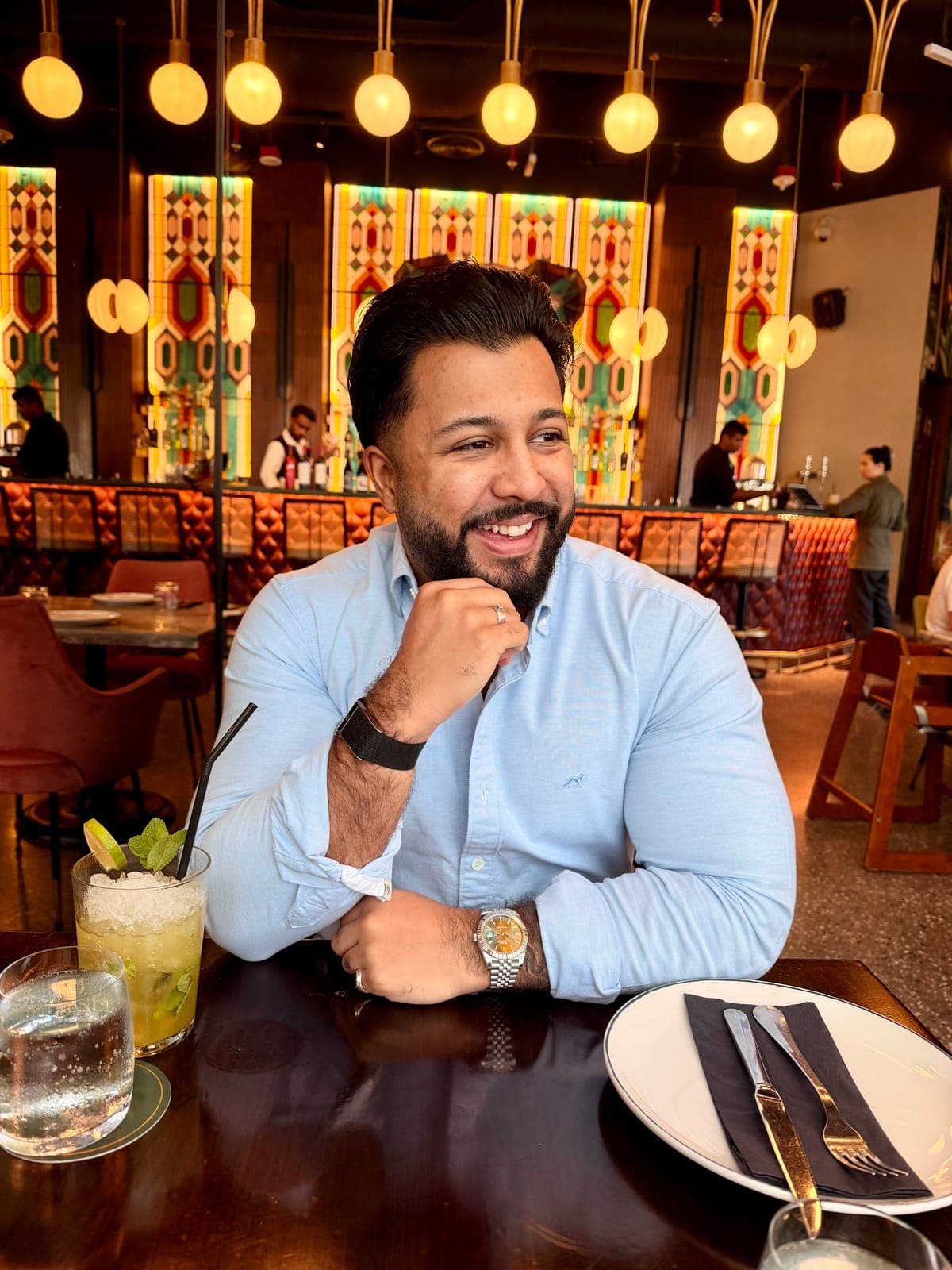
I grew up in Milton Keynes, the son of Gujarati immigrants who both worked full-time. I was the kid in the school hallway selling sweets, Red Bulls and Lucozade, then Shamballa bracelets I'd ordered in from China, then fake Obey hats and Beats by Dre until PayPal shut me down. I didn't know it was a business education at the time. It just felt like the obvious thing to do.
Later I sold watches on commission in a high-end jewellery shop. Some of the staff only had time for the people who looked rich. I paid attention to everyone, because my dad had taught me you sell human to human. To my surprise, the people quietly spending four and five thousand on a watch usually looked nothing like the part. So I started asking what they did for a living. Almost all of them were business owners. That was the click.
My dad had started his own telecoms business after humble beginnings doing warehouse work, and changed our life at home doing it.
The lesson stuck: you can sell your way out of almost any circumstance.
The path there wasn't clean. I started a chemical engineering degree for the worst possible reason, that the richest man I'd ever met had done it. I hated it. I took a year out, tried to make it big trading forex, and lost everything I had. That was the lowest I've ever been. I went back, finished the degree, and started again from zero, this time pointed at the only thing I'd ever actually been good at.
I took a brutal tech sales job selling to biotech companies, the kind where they hire twenty and keep two. I survived it, only just. At the next company my VP of sales was sacked ten days after hiring me, and I was terrified I was next. Instead I built. I hired the team, trained them, and put the whole tech stack in place. I became head of sales at 24, not because I was the best closer in the room, but because I'd built the machine that didn't need me to be. I was automating my outreach, my research, even my hiring, while everyone else did it by hand.
After a falling out with the founder, I stepped back into enterprise sales as an individual contributor instead of a team lead - I wanted to sharpen my sales skills further. Bad move. I was made redundant because the product wasn't ready for enterprise.
I lost my job, my relationship and the deposit on a flat I'd put down in London, and moved back in with my parents. That was my first 90 days of starting my agency.

At 26 I'd co-founded a cold email agency, running outbound for 50+ SaaS and tech brands. By 28 I'd sold it. I grew the business 15x that year despite all those challenges. Not because I'm tougher than anyone, but because building was the only thing keeping me upright.
Now I'm helping scale InboxKit from [10m] to 100m.
So I'm not teaching from the finish line. I'm teaching from inside a company I'm still trying to grow, with plays that are still wet paint.
I don't wear the suit and carry the briefcase I pictured as a kid. But I did become the “jet-setting businessman”, just in a tracksuit instead. And I did end up buying the watches I watched my clients purchase from me all those years ago.
But the thing I really wanted, to be the person my younger self could look up to, I'm still working on every day.
Making Plays is where I write the game down as I play it. The newsletter is the weekly note. The podcast is me thinking out loud with other operators. The Plays are the full systems, documented, so you can run them yourself instead of guessing. I don't think AI will replace salespeople. I think it'll replace the ones who keep guessing. The whole point of this is to make sure that isn't you.
And if you'd rather I built the thing with you than hand you the playbook, that's what working with me looks like.